Showing posts with label salsa. Show all posts

Thursday, June 19

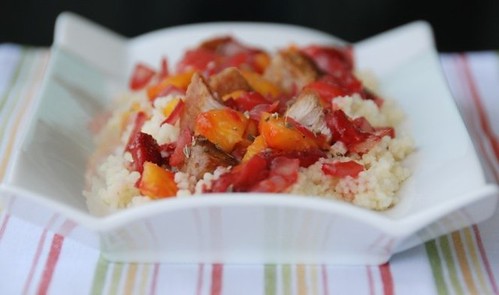
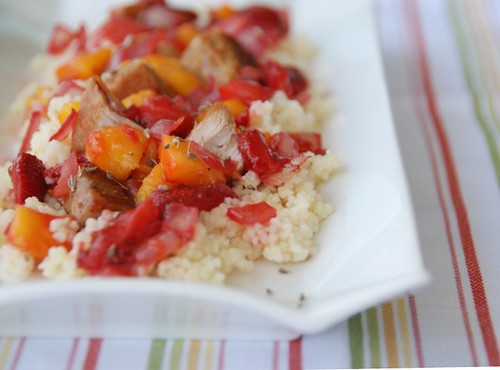
Pork Tenderloin with Strawberry-Mango Salsa

pork strawberry salsa

Strawberry season is in full swing across most of the country, so chances are you're buying lots of them. You are, aren't you? Then that also means you likely have a few soft or slightly bruised berries -- good enough to eat but not pristine enough to showcase on the top of a strawberry shortcake.

Well I'm not going to suggest you use them to make sweet jam or a smoothie (though I love both). I'm going savory with strawberries. That's right. If you've never paired strawberries with meat, then expect to be wowed. Succulent strawberries and creamy mango are enhanced with aromatic anise seed in this simple yet flavorful salsa. The fruits' sweetness provides the perfect balance to the savory, buttery flavor of the pork tenderloin.

I hope Jeanne of Cook Sister! likes savory strawberries because this is my entry for this month's WTSIM: Berried Treasure.

pork strawberry salsa cut


Pork Tenderloin with Strawberry-Mango Salsa
Serves 4
Print recipe only here.

Pork:
1 1/4 pound pork tenderloin
Salt and pepper
2 teaspoons olive oil
2 teaspoons butter

Salsa:
1 tablespoon butter
1 cup sweet onion, such as Vidalia
1 teaspoon anise seed
1 cup diced mango
2 cups chopped strawberries
salt and freshly ground back pepper, to taste
2 cups cooked grain of your choice, such as cous-cous, quinoa, or white rice.

Cut the tenderloin into medallions, and season with salt and pepper. Let stand for about 10 minutes.

Meanwhile, for the salsa, melt butter in a large skillet over medium heat. Saute the sweet onion for 3-4 minutes, or until slightly softened and browned. Stir in the anise seed and diced mango, cooking for 2 minutes more. Add strawberries and cook 2-3 minutes, until slightly softened. Season with salt and pepper. Remove from heat.

In a large skillet over medium-high heat, melt 2 teaspoons olive oil and 2 teaspoons butter. Add the pork; cook for 3-4 minutes, until crispy and browned, then flip and cook until browned all over and just cooked through (the meat should be tender).

Place cooked grain on a platter, add cooked pork, and cover with warm fruit salsa. Serve immediately.

Other meat dishes you might like:

Lamb Kebabs


Savory Sausage and Fennel Galette


Broccoli Rabe (Rapini) and Sausage Sandwich with Sharp Provolone


Save This Page on Del.icio.us

Monday, April 7

Habaneros Are Hot

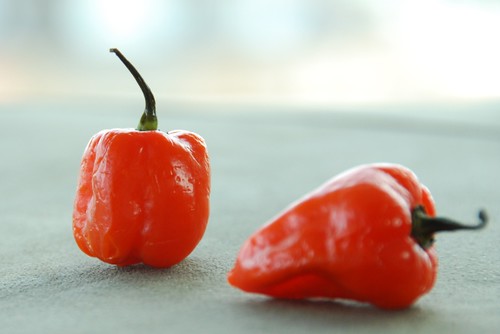
habaneros

In August 1997, and Jeff and I were at the Raleigh Farmers' Market in North Carolina. A farmer was selling a wide variety of chilies, including habaneros. I was instantly drawn to their shiny, reddish-orange skin and almost heart-like shape.

"What do habaneros taste like? I asked.

"They got kick in 'em," he said, as he chewed on a toothpick.

"Can they be eaten raw, or should I cook them?" I asked.

"You can eat 'em any way you like," he said, now twirling the toothpick between his thumb and forefinger.

"How 'bout the seeds? Should I take them out first?" I asked.
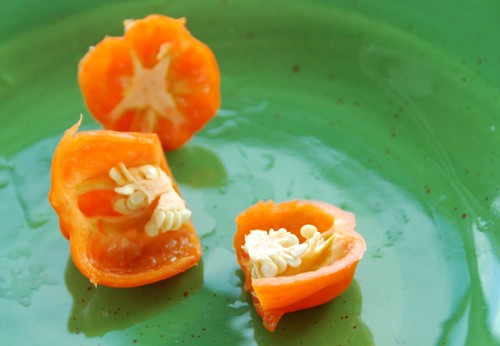
habanero seeds

"If you want to," he said.

Realizing I was just going to have to find out for myself, I quickly selected four or five brilliant habaneros, paid for them, and proudly announced to Jeff that I would make burritos with habanero salsa for dinner.

As I was preparing the salsa, Jeff sampled a tiny piece of the habanero; he coughed a couple of times and declared it "pretty hot." I decided to forgo the taste test and chopped up two habaneros, seeds and all.

We sat down to eat dinner, and I added a spoonful of my brilliant orange habanero salsa to my burrito. After the first bite, I felt a burning sensation on my lips, then my tongue started to prick with heat. Within seconds, actual flames of fire were leaping through the roof of my mouth into my nose. I tried to yelp but only gurgling sounds came out.

Jeff, realizing I was in trouble, handed me a glass of water. (This was before medical school; what did he know?) I waited for relief. Instead, like throwing water on hot oil, the fire in my mouth roared.

After a couple minutes of coughing and chest pounding, I said to Jeff, "My lipth feelths funny." I went into the bathroom and sure enough, my upper lip was swollen to twice its size. I'd always wanted fuller lips but this was ridiculous.

I've learned a few things about chilies since that memorable day. Turns out a chili's "heat" comes from a compound called capsaicin and can be measured on the Scoville Scale. Created by a chemist named Wilbur Scoville, this scale accurately measures the level of capsaicin in a chili. Scoville heat units (SHU) indicate the amount of capsaicin in a chili. For instance,
  • a red bell pepper registers a zero (you feel nothing)
  • a jalapeno = 2,500-8,000 (you feel a mild tingling sensation in your mouth)
  • a serrano = 10,000-25,000 (your lips and belly get warm and prick with heat)
  • a habanero = 100,000-350,000 (pain, not enjoyment, pain)
The Wall Street Journal not too long had a story on the world's hottest chili, the bhut jolokia, which registers over 1,000,000 SHU! At that heat, I would be afraid of dying.

Despite my initial adverse reaction, I still eat habaneros but without the seeds. And if my mouth starts to burn, I don't drink water. I eat bread or a banana; I've read that creamy foods like yogurt are supposed to work too.
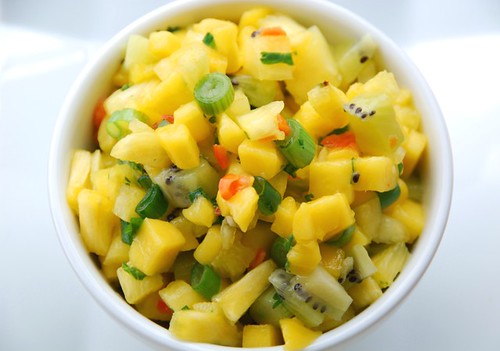
habanero salsa bowl

So please try these quesadillas with a fruity habanero salsa. The sweet pineapple, mango, and kiwi contrast pleasingly with the spicy green onions and fiery habanero. Plus the acidic lime juice helps to temper the chili's heat. It's a quick mid-week meal or easy party dish. Feel free to play around with the ingredients to your liking; after all, quesadillas are meant to be fun.

When you make them, just be sure to have some bread, bananas, and yogurt nearby, just in case.
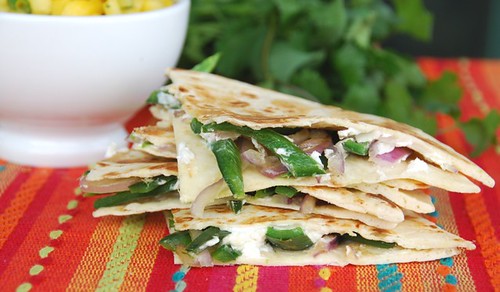
quesadilla close up

Goat Cheese and Poblano Quesadillas with Pineapple-Mango-Habanero Salsa

Make 4 quesadillas
Print recipe only here.

Salsa:
1 cup diced fresh pineapple
1 cup diced fresh mango
1 diced kiwi
1 habanero, minced, and seeds removed (unless you're a glutton for punishment)
2 green onions, thinly sliced
the juice of 1 lime
1 tablespoon minced fresh cilantro
salt, to taste

Quesadillas:
1 large or 2 small poblano peppers, de-seeded and thinly sliced
1 teaspoon canola oil
1 medium red onion, thinly sliced
1 teaspoon sugar
salt, to taste

8 (6-7- inch flour tortillas)
4 ounces goat cheese

To prepare the salsa, place all ingredients in a medium bowl and gently toss. Allow to rest for at least 30 minutes (or up to 2 hours) for the flavors to mingle.

Place poblano pepper over an open gas flame, turning occasionally, until thoroughly charred and blistered on all sides. Wrap tightly in aluminum foil and let rest for 15 to 20 minutes. Remove, and using some paper towel, gently scrape off the skin. Halve, stem and seed the pepper. Cut into strips, then dice, and place in a bowl. Set aside.

Heat a medium nonstick skillet over medium heat. Add canola oil and red onion, and saute for 3-5 minutes. Add sugar, reduce heat to low, and continue to cook until onions are caramelized, about 7-10 minutes. Add cooked poblano peppers to the skillet, season with salt, and toss to combine. Remove from heat.

Place 1 tortilla on a clean cutting board; spread with 1 ounce of goat cheese, then 1/4 of the poblano mixture. Top with another tortilla, and press lightly with your hand. Continue with remaining tortillas and filling until you complete 4 quesadillas.

Heat a large, nonstick, dry skillet over medium heat. Add 1 quesadilla. Cook until lightly browned, about 2 minutes per side. Transfer to a baking sheet and place in a warm oven (200-300 degrees F) until ready to serve. (Or eat 'em as you make 'em.) Repeat with remaining 3 quesadillas.

Cut each quesadilla into 3 or 4 wedges. Serve with salsa.

You might also like:

Note: The previous post for WEB, Weekend Eagle Blogging was a spoof. Please don't send me pictures of predatory birds with road-kill soup.


Save This Page on Del.icio.us

Wednesday, March 19

What's Better Than Desert Wildflowers? Shrimp Tacos, That's What.

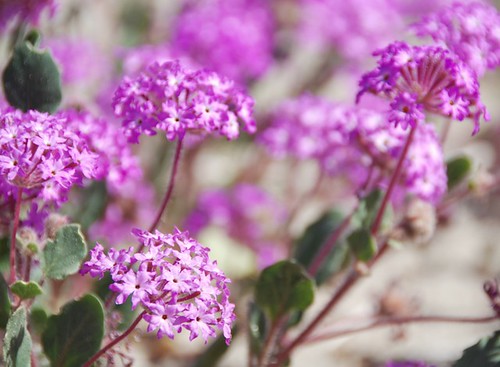
more purple wildflowers

Ever since we moved to Southern California five years ago, every spring we hear the same chorus: “You’ve got to go to Anza-Borrego. They have the most gorgeous wildflowers you’ve ever seen.”
Every spring Jeff tries to convince me to drive the 2 ½ hours to see them, and every spring I find some excuse not to. It’s not the drive (I love driving). It’s just that we have flowers everywhere we look here. Plus, I'm a fall foliage girl.
Two weekends ago, however, San Diego was all abuzz about this being the BEST wildflower season since 2005 (because of our unusually high rainfall-- a whopping 4.43 inches since last July). Jeff asked again, and I just couldn't say no. So we packed a lunch, grabbed our maps, and drove to Anza Borrego Desert State Park.
Apparently every person within the San Diego county limits decided to go to Anza-Borrego that day too. After waiting in line at the visitors’ center for nearly 30 minutes, a park ranger told us, “It’s a sea of brilliant color out there. Almost as good as 2005! You guys definitely picked the right day.” Jeff flashed me a big smile and said, “See, we picked the right day!”
We followed his directions and ended up on a dusty, dirt road. Jeff hopped out of the car, and said, “Wow! Look at those purple flowers!”
“You mean the weeds?” I said.
“They’re not weeds, they’re wildflowers. Look at them all!” he said.
“They look like weeds,” I said.

purple wildflowers at Anza-Borrego Desert Park

Anza-Borrego is technically a desert, which in my translation means sand with weeds in it. Based upon the “oohs” and “aahs” I was hearing, and the obscene number of Nikon D80's snapping pictures, it seems I was the only one not impressed.
So I went along: “Ooh, look at all those purple weeds.”

yellow wildflowers

OK, I admit, there were some lovely flowers, but the best part of the day was the ride home. We stopped at an orange and grapefruit grove where we bought a 15-pound bag of freshly picked navel oranges for $3 and a 15-pound bag of pink grapefruits for $4! Fresh fruit at a bargain price—it just doesn’t get better. I was very impressed.

fresh grapefruits and oranges

The scenery was spectacular; we finally saw the “sea of brilliant colors” we were promised, and it was awe-inspiring. We even spotted a few idyllic farms.

wildflower landscape near Anza-Borrego Desert Park

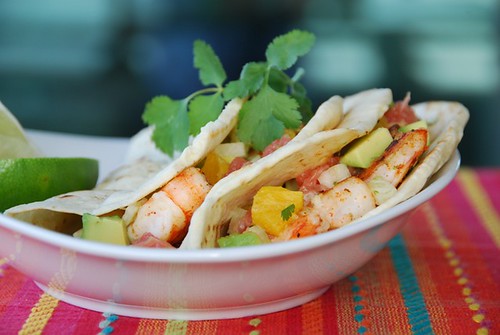
We ended the day with a simple, delicious meal of shrimp tacos with citrus-avocado salsa. Our fresh sweet oranges and tart grapefruits were tossed with creamy local avocados (from Terri, who you’ll learn more about in a later post) and sprinkled on top of spicy, crispy shrimp tacos. I took one bite and declared, “Now this was worth 5 hours of driving.”

shrimp tacos with citrus-avocado salsa

Shrimp Tacos with Citrus-Avocado Salsa
Makes 4 servings
Print recipe only here.

Salsa:
1 teaspoon extra virgin olive oil
3 scallions, finely chopped
2 teaspoons minced fresh ginger
1 ruby red or pink grapefruit, peeled, de-seeded, and diced
1 navel orange peeled, de-seeded, and diced
1/4 cup peeled jicama, diced
1 avocado, diced and sprinkled with lime juice to prevent discoloration
juice of 1 lime
1 teaspoon cayenne pepper or 1 teaspoon minced jalapeno pepper (without seeds)
1 tablespoon minced fresh cilantro

Tacos:
24 extra large or jumbo shrimp, peeled and deveined
1 tablespoon olive oil
salt and pepper, to taste

1 to 2 tablespoons canola oil, for searing shrimp
juice of 1/2 lime
1/4 teaspoon cayenne pepper
8 flour or corn tortillas

To make the salsa, simply combine all ingredients in a medium size bowl and toss gently until well combined.

Place the shrimp in a large bowl with olive oil, salt and pepper. Toss well to coat and set aside for 5-10 minutes.

Heat canola oil in a large skillet over medium-high heat. Add shrimp and cook 5 to 6 minutes, turning to ensure that they brown evenly on both sides. Squeeze the juice of 1/2 lime over the shrimp and sprinkle with cayenne pepper. Toss to coat evenly. Remove to a plate when cooked.

To assemble tacos, heat tortillas in a dry skillet over medium heat for 1 minute per side or, using metal tongs, simply hold over an open flame until warmed and slightly charred. Place three shrimp on each tortilla; serve with salsa and extra fresh cilantro for garnish. Serve immediately.

You might also like these citrus-y dishes:


Save This Page on Del.icio.us

Monday, November 26

Fuyu Part 2: Boneless Pork Chop with a Persimmon and Pomegranate Salsa

Last week I made a persimmon and date bread with super-ripe Hachiya persimmons. To be a fair and balanced blogger, today I've got a savory dish using Fuyu persimmons -- the rotund ones.

Firm Fuyus can be eaten like an apple; they taste like one too -- mildly sweet but with hints of cinnamon. Fuyu persimmons are ideal for savory dishes, such as salads and salsas, where they add color, flavor, and texture.

The first time I made this salsa, I used just persimmons and no onion, and I thought it needed a bit more splash. This time I added some savory scallions and tart pomegranate seeds. It was pleasingly splashier in both taste and presentation. This refreshing salsa pairs especially well with pork, though it would be good with roasted turkey, grilled lamb, or a mild white fish, such as mako shark (which Jeff had and loved last night).

I'm submitting this post to Kalyn of Kalyn's Kitchen, the founder and this week's host of the ever popular Weekend Herb Blogging. Persimmons aren't just pretty, they're nutritional powerhouses too--especially high in potassium, lutein (for ocular health), and lycopene (a cancer fighting antioxidant).


Boneless Pork Chops with
Persimmon and Pomegranate Salsa

Serves 4
Print recipe only here.

Salsa:
Makes about 1 1/4-1 1/2 cups

2 Fuyu persimmons, with the skins on, diced (about 1 heaping cup)
1/4 cup pomegranate seeds
2 Tbsp thinly sliced scallions
1 tsp fresh lime juice
1/2 tsp rice vinegar
1 tsp grated fresh ginger
1/8 tsp cayenne pepper
Salt, to taste
1/2 tsp fresh mint, finely chopped
1/2 tsp fresh basil, finely chopped

4 boneless pork chops
1 Tbsp olive oil
salt and pepper

For the salsa, place all ingredients from persimmons through salt in a medium size bowl. Stir until well combined. If serving within an hour, then add fresh basil and mint so the flavors will mingle. Otherwise, do not add the herbs (since they will turn brown) and place in a sealed container in the refrigerator for up to 3-4 hours. (Letting the salsa sit much longer makes it taste too astringent.)

Note: If you don't prefer the intensity of raw onions, then place the minced onions in a small-mesh colander and pour very hot or boiling water over them; drain and add to the salsa. This will remove some of their sting without sacrificing flavor.

For the pork, drizzle the olive oil on both sides of each chop and season with salt and pepper. Either grill the chops or cook on the stove top. Or for the best of both worlds, do what I did: use a grill pan on the stove top which creates those attractive sear marks but allows you to stay in the kitchen. Cook for about 5-6 minutes per side, or until well browned and cooked throughout.

Serving suggestion:
Place pork chops on top of cooked quinoa or couscous, then top with 1/4 of the salsa. Repeat with remaining 3 dishes. Garnish with additional herbs, if desired. A simple green salad with a light vinaigrette would be a nice accompaniment.

Reminder: Eat Christmas Cookies. Please check out the updated Eat Christmas Cookies post. There are several delicious treats there already. You have until December 24th to post, but try to submit by the 17th if possible so others can try your cookies. :) Click here for full details.

You might also like:

Fiery Shrimp with Avocado-Pomegranate-Tangerine Salsa served over Soft Polenta
Swordfish with Pineapple-Mango Salsa
Pan Seared Sea Scallops with Kumquats
Mexican Citrus Salad with an Orange-Lime Vinaigrette

Save This Page on Del.icio.us

Tuesday, July 31

Summer is Time for Salsa and a New Handbag

There aren’t too women I’ve met who don’t love handbags (and shoes, but that’s another post). Recently, I was in Nordstrom when I overheard two women (an attractive blonde and an attractive brunette) justifying the purchase of a bag that was almost identical to the one on the brunette's shoulder.

“Yeah, but yours is more of a mocha color," the blonde explained. "Look -- and she held the bags next to each other-- this is definitely more chocolate than mocha. You have to get it." (See, there is a connection to food already.)

The brunette walked over to an available cashier and purchased her chocolate colored bag. I was astonished. Do women love handbags that much? Then I looked around me: half of the female population of Southern California were in Nordstrom that day, and fully half of them were in line holding new handbags.

Given that most women have inherited the autosomal dominant "handbag gene," it didn't surprise me to learn that even a reusable grocery bag could generate a stir. In case you missed it, Anya Hinmarch, a posh London designer, whose handbags go for hundreds and even thousands of dollars, created an eco-friendly tote bag imprinted with the words, "I'm Not A Plastic Bag." It was designed as a fashionable way to encourage people to stop using biodegradable-resistant plastic bags. It has been selling wildly all over the world, including here in the U.S. at Whole Foods. Women here were so eager to get one of these coveted bags that they waited in line for hours. That’s nothing, however, compared to what happened in Taiwan: In a frenzy to obtain one of these bags, a stampede resulted in 30 people actually being sent to the hospital.

Though I don’t think you should trample the woman in front of you to get one, I do think a reusable tote bag is an easy way to help the environment. Since the lovely Meeta of What’s For Lunch, Honey? has asked us to share some habits that help protect the earth for this month’s mingle, I’ve decided to submit this post. Though it’s a small thing, using a canvas tote bag can make a big difference. For more about the benefits of reusable bags and for tips click here. Also, Cate of Sweetnicks and Well Fed fame likes the tote bags from reusablebags.com which are made from recycled ad banners and seatbelt straps.


Any reusable bag will do, like this nifty one from my dad, who thought I'd like it for my farmers' market trips. I do; my only problem is I can't find the right heels to go with it. Maybe I'll head back to Nordy's....


This no-cook summertime salsa is a fresh, easy way to incorporate many of your farmers' market finds. Thanks for sharing Blush, the tomato, Alanna! With juicy cantaloupe, crunchy corn, and fiery jalapenos, it's a vibrant and flavorful medley of summer's finest fruits and veggies. Served atop grilled seafood or tofu and a cooked whole grain, such as quinoa (OK, this part requires some cooking, though very little), it makes a lovely summertime meal.

Susan’s Summertime Salsa


Print recipe only here.

1 cup diced cantaloupe
1 cup diced mango
1 cup diced red or yellow bell pepper
½ cup red or yellow cherry tomatoes
½ cup chopped cucumber (peeled and de-seeded)
1 ear of fresh sweet corn (cut from cob)
¼ cup diced red onion or scallions

2 Tbsp fresh lime juice (about one small lime)
Pinch of lime zest
1 Tbsp fruity olive oil
2 tsp fresh grated ginger (about a 1-inch sized piece)
2 Tbsp minced jalapeno, with or without seeds
Salt
2 Tbsp each chopped fresh cilantro, mint, and basil

Combine the first 7 ingredients in a bowl, and toss gently to blend.

Combine the lime juice through the salt in a small bowl; whisk until fully blended. Pour on top of the fruit mixture. Serve either at room temperature or chilled. Stir in the chopped fresh herbs just before eating so they don’t turn brown.

Note:

Fresh sweet corn on the cob can be eaten raw, which is delicious and crunchy. If you've never tried it before, then give it a go. You'll be glad you did.


If you don’t like the intensity of raw onions, simply pour some boiling water over them to remove their pungency, or sauté in a bit of olive oil.


You might also like:

Minding My Peas
Swordfish with Pineapple-Mango Salsa
Funky farmers' market produce


Save This Page on Del.icio.us

Thursday, June 14

Heuvos Rancheros son Muy Deliciosos


Since I live in Southern California, I really should speak Spanish. It’s not like I don’t know any Spanish. I know a few essential phrases, such as Buenas dias. ¿Cómo esta? Muchas gracias. And ¿Puedo tener huevos rancheros, por favor?

It’s not much, but it’s gotten me by so far, especially the last one. Knowing how to ask for huevos rancheros is muy importante since it’s one of my favorite dishes for brunch. So, when Rosa of Rosa’s Yummy Yums tagged me for a brunch meme I knew exactly what to make.

I ate heuvos rancheros for the first time 10 years ago in Chapel Hill, NC. Since then, I’ve eaten heuvos rancheros all over the country, from San Diego, CA to Miami, FL, and I can say two things for certain about them:

1. I’ve never had heuvos rancheros prepared the same way twice.
2. I’ve never had a dish of heuvos rancheros I haven’t liked.

Heuvos rancheros refers to a dish containing eggs and tortillas. It is one of those gloriously laid back dishes that seems to turn out well no matter how much (or little) effort goes into making it and no matter which ingredients are used. As with any regional dish, I’m sure there are many recipes for “the right way” to make them. If so, I don’t have it. I’m always altering the ingredients based on what is available seasonally and what I’m in the mood to eat.

One of the best I’ve ever had was in a diner in Albuquerque, NM, where they served the eggs fried, topped with black beans, and two sauces: a red and a green mole. Despite my efforts to replicate these moles, I never have quite achieved it. That’s ok. I’ll be happy to keep trying.

Regarding the eggs, I’ve had them fried, scrambled, and sunny side up, so it just depends on what you like. Though they’re usually served on soft corn tortillas, I’ve also made them on crispy corn tortilla chips and on whole wheat tortillas as well.

As for toppings? It’s up to you. Black beans are typical, but I like pinto as well as other veggies including peppers, potatoes, corn, and chayote squash. And for the cheese? From sharp cheddar to Jack to Cotija, they’re all good. Sour cream and guacamole are typical, but I like them without. And I’ve had all types of savory sauces: from fiery to sweet moles and various salsas.


For this post, I made one of my favorite (and easiest) versions with a salsa verde (green salsa) since the farmers’ market has just starting selling this season’s fresh crop of tomatillos. If you’re not familiar with tomatillos, pronounced (toh-MAH-tee-YOS), they look like a green tomato, but they’re actually a member of the gooseberry family. They are small, green spherical fruit that are encased in a papery husk and are often used in Mexican and Southwestern cooking. They have a slightly tart flavor, not unlike a Granny Smith apple, and sometimes taste lemony. When buying tomatillos, look for bright green fruits (not yellow or brown, which means they’re old), and make sure the papery husk is smooth and tight on the fruit, not shriveled or blackened. Tomatillos can be eaten raw or cooked.

For this sauce I roast the tomatillos, which mellows their tartness and pair them savory onions, fiery jalapenos, and tangy lime for a sauce with a little kick. The entire dish is pretty low-calorie yet filling, but you can add/substitute ingredients to your liking.

Tell me, do you enjoy heuvos rancheros and make them at home? If so, what’s your favorite way to prepare them? I’m always looking for new ideas.


Heuvos Rancheros with Salsa Verde
Makes 4 servings.
Print recipe only here.

½ cup white onion
1 small jalapeno with seeds
8-10 small tomatillos, husks removed, and quartered
1 tsp canola oil
The juice of ½ lime
1-2 Tbsp fresh cilantro, chopped
Salt, to taste
1 (15-oz) can black beans, rinsed

8 eggs
8 (6-inch) corn tortillas

Optional garnishes:
Shredded sharp cheddar cheese
Sour cream or Mexican crema
Additional fresh cilantro
Diced avocado

To make the salsa, preheat broiler. Place tomatillos, onions, and whole jalapeno in an oven proof dish; add 1 tsp canola oil, and toss to coat. Place under broiler for about 10 minutes, or until brown spots begin to appear on the vegetables. Remove from broiler; let cool for a few minutes. Place in a blender; add lime juice, cilantro, and salt. Blend until coarsely mixed.

Meanwhile, heat black beans on stovetop or in microwave.

Beat eggs in a small bowl; scramble on stovetop for 2-3 minutes, or until at desired doneness. Alternatively, you can pan fry the eggs in a little canola oil. It’s a matter of preference.

To heat tortillas, simply place a tortilla directly over the flame of a stovetop burner. Using a pair of tongs, turn it several times to prevent it from burning, until it’s warmed through but still soft to the touch. Keep tortillas wrapped in foil to stay warm until ready to serve. Alternatively, place tortillas in a warm oven (about 250 degrees) for 8-10 minutes, or until warmed through but still soft to the touch.

For each serving, lay two warmed tortillas on plate, top with ¼ scrambled eggs, ¼ heated black beans, ¼ tomatillo salsa, and desired garnishes.

For more on tomatillos, check out this tasty post from Jeff of C for Cooking.

Save This Page on Del.icio.us

Monday, May 7

You Can Make a Lot of Salsa with a Case of Mangoes

If you’re familiar with my blog, then you know I love farmers’ markets. A week without a trip to the farmers' market is like a week without the sun: it makes me grumpy. I can’t remember the last time I bought produce in a regular grocery store. Sure, I go to the supermarket for eggs, milk, and cereal, but fruits and vegetables come from the farmers. So, what I did other day, shocked me. I tell myself it a was just a transgression.

I was at Costco stocking up on bottled water, protein powder, and toilet paper (why two people need 36 rolls of Northern toilet tissue, I’ll never know). On my way to the protein powder, I passed pineapples, tall, fragrant, ripe pineapples each topped with a crown fit for a king. They had no brown spots, no fuzzy fur on the bottoms—they were perfect. Better yet, they were only $2.99 each. I couldn’t believe it! I put two in my carriage and buried them under the toilet paper.

Not 20 feet later on my way to the water, I passed a mountain of mangoes, whose green and yellow skins were taut and unblemished. Having just paid $1.75 each for some (which weren’t even good), I stopped to check the price -- $8 for a whole case! I debated whether or not to buy them. What would we do with a whole case of mangoes? Would they be sweet? What if they all ripened at the same time? Then I heard my father’s voice in my head saying, “Buy them! They won’t go to waste." “But Dad, it’s only the two of us.” “Just buy them!” the voice echoed. After scanning left and right, I picked up a case and placed it in the carriage. What did I think? That the Farm Bureau was watching me on the surveillance camera? Feeling guilty, I wondered if the toilet paper could cover these too.

When Jeff came home from work that night, he saw the behemoth bowl of mangoes and pineapples on the counter and asked, "Costco?" "Costco," I replied.

That night we enjoyed a pineapple-mango salsa on swordfish for Jeff and tofu for me. Fruit salsas are a staple in our house because they're light, healthy, and versatile. This salsa is sweet, spicy, and tangy and tastes even better when allowed to rest at room temperature before serving. Also, the rich golden yellow of both fruits seemed just right to submit to Barbara's A Taste of Yellow event at the famed Winos and Foodies. In addition to raising awareness of cancer, Barbara's event has been approved by the Lance Armstrong Foundation as an official LIVESTRONG Day Event.

Swordfish with Pineapple-Mango Salsa
Print recipe only here.

1 cup fresh pineapple, diced
¾ cup mango, diced
1 small red or green chile, finely diced
3 Tbsp green onions, finely sliced
Juice of ½ lime
1 Tbsp fresh mint, finely chopped
1 Tbsp fresh cilantro, finely chopped
Salt, to taste

2 (4-oz) swordfish steaks or mahi-mahi
1 tsp olive oil
Salt and pepper

For the salsa, simply place all ingredients in a bowl; allow to rest for at least 45 min- 1 hr. so the flavors will mingle.

Preheat the broiler. Drizzle the olive oil on both sides of the swordfish, and season with salt and pepper. Broil for 4-5 minutes, flip over steaks, and broil another 4-5 minutes, or until opaque. Alternatively, you can grill the swordfish or pan fry on the stovetop. Makes 2 servings.

Serving suggestion: steamed sugar snap peas lightly seasoned with extra virgin olive oil, fresh mint, & salt and pepper are a lovely side vegetable.

If you're unfamiliar with selecting and cutting a mango, then check out Rachel’s tutorial at Coconut and Lime.


Save This Page on Del.icio.us