Showing posts with label persimmons. Show all posts

Friday, November 28

What is a Persimmon?

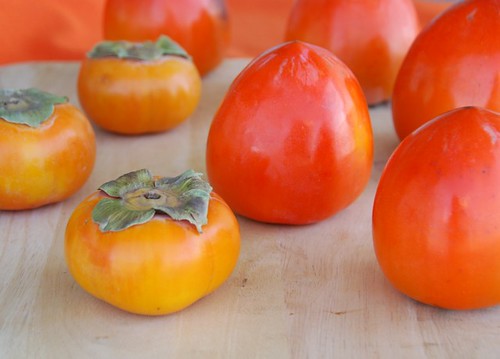
persimmons-- round Fuyus and heart-shaped Hachiyas
(round Fuyus on left, heart-shaped Hachiyas on right)

I was selecting persimmons at the farmers' market last weekend, when the woman next to me leaned in close so that the farmer wouldn't hear her and whispered, "I bought some of those last year and they were awful."

"Really?" I asked, surprised that anyone could use the words "awful" and "persimmon" in the same sentence.

"Yeah. Especially the ones with the pointy bottoms. They're so bitter," she added.

"You mean like a green banana?"

"Yes! Exactly!" she said, and gave an involuntary shudder.

"That's because you ate it when it wasn't ripe. Those are called Hachiya persimmons; they need to be really, really soft before you eat them."

"Well, someone told me that I could eat persimmons like an apple," she said, confused.

"Yeah, the Fuyus, not the Hachiyas. There's a big difference."

"Well I wish I had known that last year. I ended up using them as a centerpiece for my Christmas table, then threw them away."

Threw them away? That's when I involuntarily shuddered.

That's the problem with persimmons. Eat an unripe Hachiya, and you could banish them from your life forever. But, oh, what a mistake that would be! A ripe Hachiya is pure bliss -- glossy, jelly-like coral colored flesh that tastes like sweet mangoes and apricots.

I don't ever want anyone to throw away a persimmon again, so I'm here to help. Read on to learn all about persimmons.

Though persimmons are well-loved throughout many parts of the world -- they are Japan's national fruit -- they puzzle many Americans who are unfamiliar with them. That's why it helps to have a well-educated farmer like Barry Karol of Karol's Tropical Fruit Farm to help you out. With persimmon season running from late October through December, Barry has been talking up persimmons a lot lately.

Persimmons are a winter fruit, so I asked Barry why they do well in San Diego. He explained, "There are 14 climates zones in San Diego. It's actually the most diversified agricultural place on the planet. That's why persimmons grow so well here."

You don't have to live in San Diego to enjoy persimmons; they are typically available in most supermarkets during the holiday season. Here are some pointers to help you select the best ones.
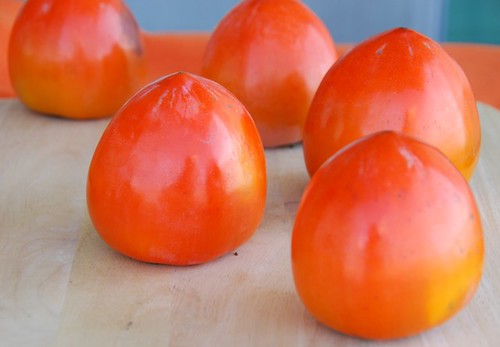
Hachiya persimmons
(heart-shaped Hachiya persimmons must be eaten very ripe)

Heart-shaped Hachiya persimmons have a shiny deep orange skin that may be streaked with black. Don't worry. Barry says those are just sun spots.
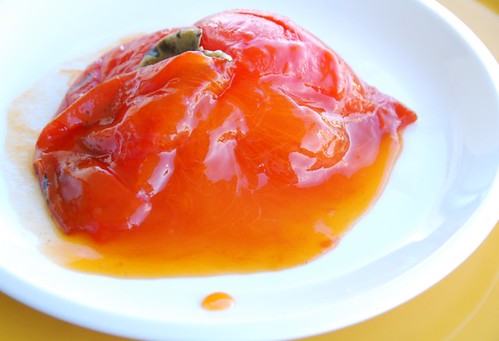
a fully ripe Hachiya persimmon
(a fully ripe Hachiya persimmon)

Hachiyas are astringent, which means they can be eaten only when fully ripe. How can you tell when a Hachiya persimmon is ripe? Hold it in your hand. It should feel like it's filled with water and will be extremely soft and squishy. Removing the thin skin reveals coral colored flesh so thick and glossy it looks like jelly and tastes like it too -- it's an intoxicating blend of mango and apricot. Eat them plain or use them in baked goods, sauces, and smoothies.

Just remember: DO NOT eat an unripened Hachiya. It can take up to a week to ripen, so to speed things up, place the fruit with a banana inside of a paper bag. The banana releases ethylene, which speeds up the ripening process.
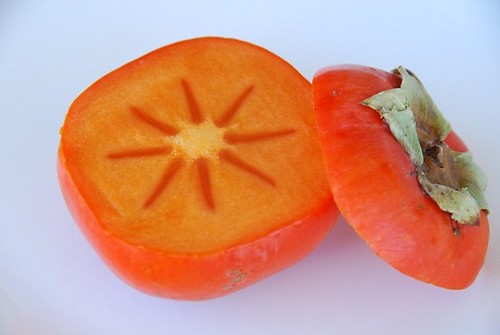
Fuyu persimmon
(a Fuyu persimmon can be eaten hard or soft)

Fuyu persimmons in contrast are squat and rather heavy for their size. Their skin ranges from pale yellow-orange to brilliant reddish-orange; generally, the darker the color, the sweeter the taste. Fuyu persimmons are non-astringent, which means you can eat them either firm or soft. Firm Fuyus can be eaten like an apple, skin and all. And when you slice off the top, a beautiful star will appear in the flesh. Crunchy cinnamon flavored Fuyus are also great in salads and salsas.

Persimmons are highly nutritious. One fruit packs 55% of your daily vitamin A. According to Barry, "Persimmons are high in beta-carotene. In their raw form they're more nutritious; once they're heated, they lose some of their nutritional value."

I hope that I have saved at least one more person from the horrifying experience of eating an unripe Hachiya. So please, this holiday season, eat persimmons instead of just using them in your centerpiece.

persimmon sundae
(Persimmon, Gingersnap, and Caramel Sundaes)

To learn more about persimmons and their history, check out my latest NPR Kitchen Window article, "Falling for Persimmons," which includes four recipes:

Here are more persimmon recipes from my blog:

If you're in San Diego, then check out our amazing farmers' markets. You can catch Barry at the Little Italy Farmers' Market on Saturday mornings and the Hillcrest Farmers' Market on Sunday mornings. He doesn't have a web site, but he gave me his business card with his email: barrykoral [at] hotmail [dot] com. I'm sure he'd be happy to hear from you if you have questions or comments.


Save This Page on Del.icio.us

Thursday, October 30

Dandelion, Persimmon, and Medjool Date Salad

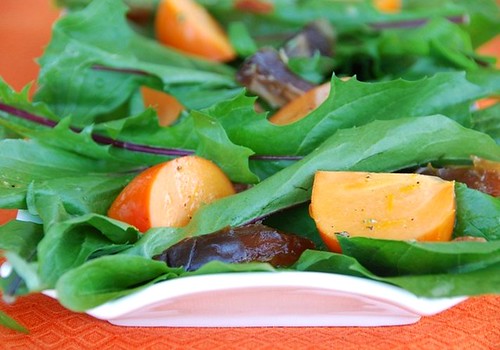
dandelion, persimmon, and Medjool date salad

Do have any weeding to do? If so, you may want to keep the dandelion greens for your next salad. No kidding. Look at the definition of dandelion greens: edible leaves of the common dandelion collected from the wild; used in salads and in making wine.

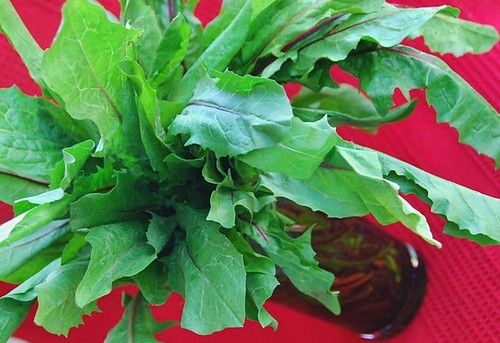
People have eaten dandelions for centuries. The name comes from the French, who called them dent de lion, or "lion's teeth" because of their sharp, serrated leaves. In fact, all parts of the dandelion are edible, though most people prefer the leaves to the flower and the root. You can harvest dandelions in your yard, especially during the spring and fall when they're at their tastiest, but I buy mine at the supermarket.

dandelions

Dandelion greens have a bitter flavor similar to chicory, endive, and escarole and are best when paired with sweet or salty foods. Try them raw in salads or cooked; they can be boiled, steamed, or lightly sauteed. Also, season them generously with salt, which reduces the bitterness.

If, like me, you like a "bite" in your salad greens, then you won't be disappointed with this Dandelion, Persimmon, and Medjool date Salad. My inspiration came from a particularly productive trip to the farmers' market on Sunday morning where I purchased crisp Fuyu persimmons and succulent Medjool dates. The sweet fruit acts as a foil to the bitter salad greens which are drizzled with a deliciously tangy vinaigrette made of honey, Dijon mustard, orange juice, and fresh rosemary.

Now, just think of all the money you'll save by not having to purchase any more weed killer.

Dandelion, Persimmon, and Medjool Date Salad
Makes 4 servings
Print recipe only here.

Vinaigrette:
1 tablespoon plus 1 teaspoon extra virgin olive oil
1 tablespoon apple cider vinegar
1 teaspoon grainy Dijon mustard (or regular Dijon plus 1/2 teaspoon mustard seeds)
1 teaspoon honey
2 tablespoons orange juice
1/2 teaspoon orange zest
1/2 teaspoon minced fresh rosemary
salt and pepper, to taste

Salad:
2 bunches dandelion greens, washed, stems removed, and chopped**
2 small Fuyu persimmons, each cut into 6 wedges
4 Medjool dates, thinly sliced
2 tablespoons lightly toasted pecans, sliced lengthwise

For the vinaigrette, whisk all ingredients in a small bowl and set aside.

In a large bowl, add the dandelions and persimmons. Pour half of the vinaigrette and toss until coated. Divide evenly among four plates. Add dates and pecans to each plate. Drizzle with the remaining vinaigrette.

**Dandelion greens are available at most supermarkets as well as organic specialty markets. Bitter greens such as chicory, frisee, and endive make good substitutes.

You might also like:

Watercress, Seckel Pear, and Brie Salad


Bulgur Salad with Chickpeas, Cranberries, and Toasted Almonds


Broccoli Rabe (Rapini) on Crispy Polenta with a
Rosemary-Goat Cheese Sauce


This week Kalyn of Kalyn's Kitchen is celebrating her third year anniversary of Weekend Herb Blogging. In fact, it will be Kalyn's last official hosting since she is passing the torch to Haalo of Cook (almost) Anything At Least Once. Thank you, Kalyn, for your time, dedication, and enthusiasm.

Save This Page on Del.icio.us

Wednesday, November 21

Persimmons, Russell Simmons, and Fuyu: Setting the Record Straight and Baking a Bread

It is a little known fact that I can speak Japanese. True, I only know two words, but I say them well.

1. Hachiya. No, it is not a greeting. It’s a persimmon.

2. Fuyu. No, not the clothing line (that’s FUBU). They are also persimmons. Not to be confused with Russell Simmons (who incidentally created Phat Farm, not FUBU).

There are about a dozen varieties of persimmons grown throughout the world; only two are generally found in the States: Hachiya and Fuyu (Fuyugaki). Both are Japanese.

Though Hachiya and Fuyu persimmons are both fun to say and have similarly pumpkin colored skin, they are different in shape, texture, and culinary use. It’s important to know the difference between them; otherwise, your persimmon eating experience will be memorable for all the wrong reasons.

Hachiya persimmons are acorn shaped (see middle persimmon above) and have deeper orange skin with black streaks on it. They are astringent, which means they can be eaten only when fully ripened. A ripe Hachiya is extremely soft and should be squishy in your hand. Removing the thin skin reveals coral colored flesh so thick and glossy it looks like marmalade, and tastes like it too -- it's pleasingly sweet with hints of mango and apricot. Though they can be enjoyed raw, Hachiyas are really prized for baking.

Heed this advice: DO NOT eat an unripened Hachiya. It's like biting into a very green banana. Your mouth will become dry and chalky, and you will contort your face into unattractive expressions that will frighten your companions.

Fuyu persimmons in contrast are apple shaped and rather heavy for their size. Their skin ranges from pale yellow-orange to brilliant reddish-orange; generally, the darker the color, the sweeter the taste. Fuyu persimmons are non-astringent, which means you can eat them either firm or soft. Firm Fuyus can be eaten like an apple, and their crunchy flesh tastes like a sweet apple dusted with cinnamon. Soft, riper Fuyus can be also used for baking.

California persimmons are harvested from October to December, so it's the ideal time to make today's recipe: Persimmon and Date Bread from Food to Live By written by Myra Goodman, who along with her husband, Drew, run Earthbound Farm in San Juan Bautista, California. My cookbook is courtesy of Lillie, a lovely young woman who interned at Earthbound Farm this summer and graciously sent me a copy.

Infused with aromatic Chinese five-spice powder and ground cloves, this cake fills your home with warm aromas of autumn. The creamy Hachiya persimmons and honeyed Medjool dates create an exceptionally moist cake that is perfect for breakfast or an afternoon snack with a cup of tea. It is spicy (which I like), but if you don't, then I would suggest omitting the Chinese-five spice. The only change I made to the recipe was omitting 2 extra Tbsp of oil.

I am submitting this recipe to Leslie of Definitely Not Martha, who has chosen Beta Carotene Harvest for this month's Sugar High Friday. Though I love sweet potato pie and pumpkin bread, I thought this persimmon bread would be a delicious, beta carotene packed entry.

Persimmon and Date Bread
Print recipe only here.

Butter or cooking spray, for greasing the loaf pan
2 large eggs
1/2 cup canola oil
2 very ripe Hachiya persimmons, peeled and mashed (about 1 cup)
1/2 cup chopped pitted dates (I used Medjools)
1/2 cup chopped walnuts, toasted
1 1/4 cups unbleached all-purpose flour
1 cup sugar
1 tsp baking soda
1/2 tsp baking powder
1/2 tsp salt
1/2 tsp Chinese five-spice powder
1/2 tsp ground nutmeg
1/2 tsp ground cinnamon
1/4 tsp ground cloves

To toast the walnuts, spread nuts in a single layer on a rimmed baking sheet. Bake for 5 minutes, then stir them. Bake another 3-5 minutes, until they are lightly colored and fragrant.

Position a rack in the center of the oven and preheat to 350 degrees F. Butter or coat with cooking spray a 5 by 9-inch loaf pan and set aside.

Place the eggs and oil in a medium-size bowl and whisk to combine. Add the persimmons, dates, and walnuts and stir to blend.

Place the flour, sugar, baking soda, baking powder, salt, five-spice powder, nutmeg, cinnamon, and cloves in a large bowl and whisk to blend. Add the egg mixture and stir to combine. Do not overmix or the bread will be tough. Pour the batter into the prepared loaf pan.

Bake the bread until a toothpick inserted in the center comes out clean, 60-70 minutes.

Let the bread cool on a wire rack for 15 minutes. Remove the bread from the pan and return it to the rack to finish cooling. Serve warm or at room temperature. The breakfast bread can be tightly wrapped in plastic wrap and refrigerated for up to a week.

You might also like:

Torte di Mele (Tuscan apple cake)
Date, Fennel, and Pistachio Scones
Olive Oil Cake with Rosemary and Lemon
Roasted Acorn Squash with Medjool Dates and Toasted Almonds

Here are more tasty persimmon recipes I'd like to try:

Chow Hound's Boozy Persimmon Pudding (made with brandy)
Nora's Persimmon Tart
Susan V's Persimmon Bread

Save This Page on Del.icio.us