
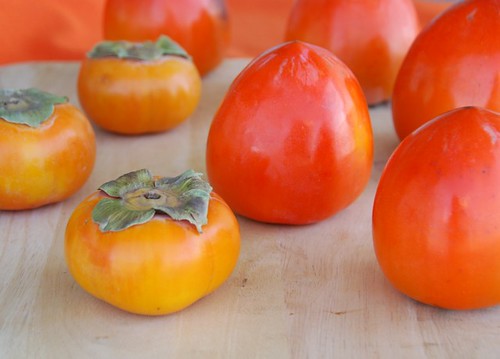
(round Fuyus on left, heart-shaped Hachiyas on right)
I was selecting persimmons at the farmers' market last weekend, when the woman next to me leaned in close so that the farmer wouldn't hear her and whispered, "I bought some of those last year and they were awful."
"Really?" I asked, surprised that anyone could use the words "awful" and "persimmon" in the same sentence.
"Yeah. Especially the ones with the pointy bottoms. They're so bitter," she added.
"You mean like a green banana?"
"Yes! Exactly!" she said, and gave an involuntary shudder.
"That's because you ate it when it wasn't ripe. Those are called Hachiya persimmons; they need to be really, really soft before you eat them."
"Well, someone told me that I could eat persimmons like an apple," she said, confused.
"Yeah, the Fuyus, not the Hachiyas. There's a big difference."
"Well I wish I had known that last year. I ended up using them as a centerpiece for my Christmas table, then threw them away."
Threw them away? That's when I involuntarily shuddered.
That's the problem with persimmons. Eat an unripe Hachiya, and you could banish them from your life forever. But, oh, what a mistake that would be! A ripe Hachiya is pure bliss -- glossy, jelly-like coral colored flesh that tastes like sweet mangoes and apricots.
I don't ever want anyone to throw away a persimmon again, so I'm here to help. Read on to learn all about persimmons.
Though persimmons are well-loved throughout many parts of the world -- they are Japan's national fruit -- they puzzle many Americans who are unfamiliar with them. That's why it helps to have a well-educated farmer like Barry Karol of Karol's Tropical Fruit Farm to help you out. With persimmon season running from late October through December, Barry has been talking up persimmons a lot lately.
Persimmons are a winter fruit, so I asked Barry why they do well in San Diego. He explained, "There are 14 climates zones in San Diego. It's actually the most diversified agricultural place on the planet. That's why persimmons grow so well here."
You don't have to live in San Diego to enjoy persimmons; they are typically available in most supermarkets during the holiday season. Here are some pointers to help you select the best ones.
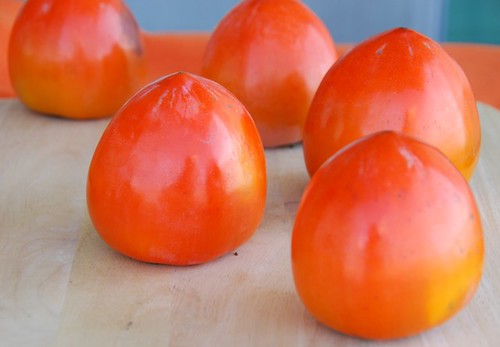
(heart-shaped Hachiya persimmons must be eaten very ripe)
Heart-shaped Hachiya persimmons have a shiny deep orange skin that may be streaked with black. Don't worry. Barry says those are just sun spots.
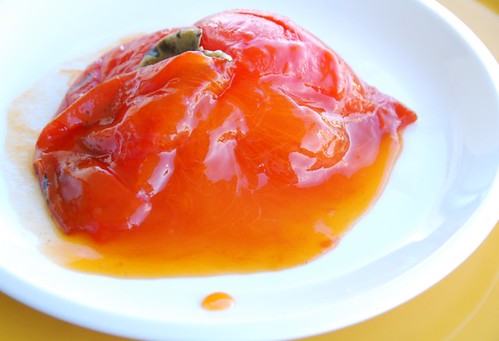
(a fully ripe Hachiya persimmon)
Hachiyas are astringent, which means they can be eaten only when fully ripe. How can you tell when a Hachiya persimmon is ripe? Hold it in your hand. It should feel like it's filled with water and will be extremely soft and squishy. Removing the thin skin reveals coral colored flesh so thick and glossy it looks like jelly and tastes like it too -- it's an intoxicating blend of mango and apricot. Eat them plain or use them in baked goods, sauces, and smoothies.
Just remember: DO NOT eat an unripened Hachiya. It can take up to a week to ripen, so to speed things up, place the fruit with a banana inside of a paper bag. The banana releases ethylene, which speeds up the ripening process.
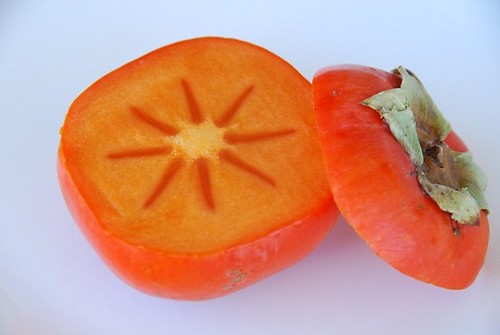
(a Fuyu persimmon can be eaten hard or soft)
Fuyu persimmons in contrast are squat and rather heavy for their size. Their skin ranges from pale yellow-orange to brilliant reddish-orange; generally, the darker the color, the sweeter the taste. Fuyu persimmons are non-astringent, which means you can eat them either firm or soft. Firm Fuyus can be eaten like an apple, skin and all. And when you slice off the top, a beautiful star will appear in the flesh. Crunchy cinnamon flavored Fuyus are also great in salads and salsas.
Persimmons are highly nutritious. One fruit packs 55% of your daily vitamin A. According to Barry, "Persimmons are high in beta-carotene. In their raw form they're more nutritious; once they're heated, they lose some of their nutritional value."
I hope that I have saved at least one more person from the horrifying experience of eating an unripe Hachiya. So please, this holiday season, eat persimmons instead of just using them in your centerpiece.

(Persimmon, Gingersnap, and Caramel Sundaes)
To learn more about persimmons and their history, check out my latest NPR Kitchen Window article, "Falling for Persimmons," which includes four recipes:
- Harvest Salad with Persimmons
- Persimmon and Granny Smith Apple Salsa
- Spiced Persimmon and Walnut Muffins
- Persimmon, Gingersnap, and Caramel Sundaes
Here are more persimmon recipes from my blog:
- Winter Jewel Fruit Salad with Honey-Citrus Glaze
- Dandelion, Persimmon, and Medjool Date Salad
- Boneless Pork Chops with Persimmon and Pomegranate Salsa
- Persimmon and Date Quick Bread
If you're in San Diego, then check out our amazing farmers' markets. You can catch Barry at the Little Italy Farmers' Market on Saturday mornings and the Hillcrest Farmers' Market on Sunday mornings. He doesn't have a web site, but he gave me his business card with his email: barrykoral [at] hotmail [dot] com. I'm sure he'd be happy to hear from you if you have questions or comments.
 Save This Page on Del.icio.us


